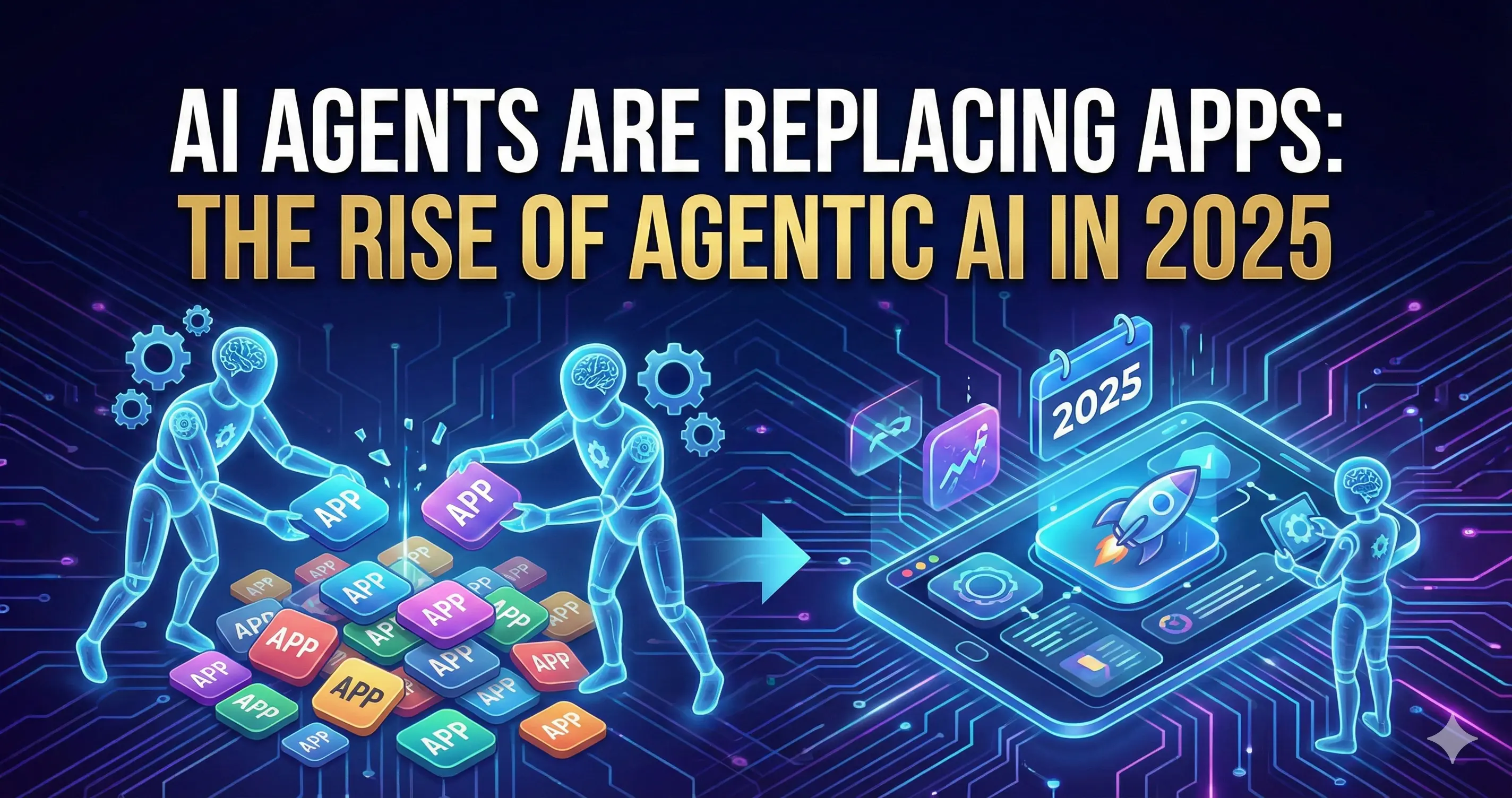
What exactly is agentic AI?
Most people first met AI through chatbots: question-and-answer systems that react to a prompt and then stop. Agentic AI extends this idea. An AI agent can interpret a goal, plan a sequence of steps, call tools or APIs, monitor progress and adjust when something goes wrong — often over minutes, hours or even days.
You can think of a traditional app as a neatly organized toolbox. You open it, tap a few icons, and something happens. An agent is more like a junior colleague. You say, “Book me the cheapest train to Lahore tomorrow that arrives before 10 a.m., then send the ticket to my manager,” and the agent:
- breaks your request into sub-tasks,
- calls different travel APIs and calendar services,
- checks constraints (budget, timing, preferences), and
- confirms back only once the whole workflow is complete.
Under the hood, this behavior combines generative models with planning, memory and tool-calling frameworks such as LangChain, LangGraph, tool-use APIs, or orchestration layers like Google Vertex AI and Azure AI Services.
Why agents are starting to beat standalone apps
Apps were designed for a world where humans do the navigation. You remember which icon to tap, which screen has which setting, and how to move data between tools. That made sense when computers were bad at language and planning. But in 2025, the friction of juggling dozens of apps is becoming too obvious to ignore.
AI agents have three big advantages:
1. From user workflows to goal workflows
Apps force you to think in terms of screens and menus. Agents let you think in terms of goals. Instead of:
- open CRM → export CSV → clean data in a spreadsheet → paste chart into a slide,
you say: “Prepare a 5-slide update on last quarter’s churn for enterprise customers” — and the agent figures out which tools and queries to run. This is the shift analysts at McKinsey describe as moving from “information” to “action.”
2. Cross-app memory and context
Every app knows only its own world. Your calendar doesn’t remember the tone of last week’s customer call; your code editor doesn’t know the business deadline behind a feature. An agentic system can maintain a single memory layer over chat, documents, tasks and code. That allows it to make more human-like trade-offs: delaying one task because another is more urgent, or proactively flagging a risk before you ask.
3. Continuous improvement instead of version updates
Apps ship updates a few times a month. Agents can learn from every interaction. With the right guardrails, feedback loops and evaluation pipelines — the kind being explored by OpenAI, Google DeepMind and research communities on Hugging Face — an agent can become more competent without the user manually updating anything.
Where AI agents are already working in 2025
If you work in tech, you may already be using agents without realizing it. Early deployments show up in surprising places:
- Customer support: multi-step agents that classify a ticket, read previous conversations, check order status and propose a draft reply — all before a human steps in. Companies like Zendesk and Salesforce Einstein are racing in this space.
- Developer tools: systems that open pull requests, write tests, refactor code and even manage CI pipelines, powered by platforms such as GitHub Copilot and AWS AI services.
- Productivity suites: orchestrators inside Microsoft Copilot and Google Workspace AI can schedule meetings, summarize long threads and rewrite documents in one chain of thought.
- Operations & IT: agent meshes that watch logs, raise incidents and propose remediation steps, described in case studies from McKinsey and infrastructure vendors.
- Knowledge work: personal research agents that crawl internal knowledge bases, summarize standards like the NIST AI RMF and prepare briefings for decision-makers.
None of these experiences feel like “installing an app.” Instead, you see a new sidebar, a chat window or an invisible worker taking actions on your behalf. The app is still there in the background — but the agent is now the primary interface.
Graph: From apps to agents — adoption curve
To understand how quickly this is happening, it helps to picture a simple trend: the share of digital workflows handled directly inside apps versus those started through an agent interface.
Illustrative data: by 2025, a significant portion of everyday workflows in forward-looking organizations already start with an AI agent instead of a menu or button. The exact percentages will vary by industry, culture and regulation.
Early-adopter companies — from cloud leaders like Google Cloud to enterprise vendors covered by the World Economic Forum — are already treating agents as a core platform capability rather than a feature. That mindset shift is what allows them to redesign end-to-end journeys instead of sprinkling AI into isolated screens.
Designing good agents: autonomy, tools and guardrails
It’s easy to imagine an all-powerful digital worker that simply “does everything.” Real production agents are more modest — and more carefully engineered. A well-designed agent balances three elements:
Clear scope and autonomy level
An agent that can “do anything” is a governance nightmare. Instead, practitioners often define a tight mission boundary:
- a billing agent that can issue refunds up to a certain amount,
- a marketing agent that can propose campaigns but not deploy them,
- a code-review agent that can comment on pull requests but not merge them.
Within that boundary, the agent gets room to plan and act. Outside it, it must escalate to a human.
Tooling surface
An AI agent is only as useful as the tools you expose to it: APIs, databases, messaging systems, robotic processes. Frameworks like the Model Context Protocol (MCP) and enterprise integration platforms from Solace or IBM are emerging to standardize how agents discover and call those tools safely.
Guardrails and evaluation
As stories of agents mis-configuring systems or deleting the wrong files remind us, autonomy without guardrails is dangerous. That’s why many organizations are experimenting with:
- policy-aware tool wrappers,
- pre-deployment “red-teaming” of agents,
- continuous evaluation pipelines, and
- auditable logs aligned with guidance from bodies like the OECD and EU AI regulators.
Graph: Workflows handled by agents vs. humans
One practical way to think about 2025 is not “Will apps disappear?” but “Which kinds of work are actually being handed to agents today, and which remain stubbornly human?”
Tasks with clear structure and digital inputs — like routing support tickets or optimizing cloud resources — are easiest to hand to AI agents. Ambiguous work that mixes politics, empathy and long-term trust remains largely human.
This division is echoed in reports from organizations like McKinsey Global Institute and policy discussions at the UN AI Advisory Body: agents are amplifiers, not full replacements for human judgment.
Video: How big tech sees the future of agents and apps
In this conversation, Microsoft CEO Satya Nadella discusses how AI agents will sit at the center of the user experience — orchestrating operating systems, productivity tools and custom business workflows. It echoes the same pattern we see across the industry: the future interface is less about tapping apps and more about collaborating with capable digital teammates.
Risks, failures and governance challenges
Whenever software becomes more autonomous, its failures become more interesting — and more serious. Agentic AI is no exception. The same properties that make agents powerful (planning, memory, tool access) can magnify mistakes if constraints are not clear.
Practitioners worry about several failure modes:
- Over-confident automation: an agent that silently executes a risky command rather than asking for confirmation.
- Prompt injection and tool abuse: malicious content that tricks an agent into exfiltrating data or calling dangerous tools — a growing focus area for security teams and communities like the OWASP Foundation.
- Lack of auditability: unclear logs, making it hard to reconstruct “who did what” when agents, humans and other systems all interact.
- Quiet bias amplification: agents trained on historical data that carry over unfair patterns unless organizations deliberately monitor and correct them.
That is why regulators, standards bodies and researchers — from the NIST AI Risk Management Framework to the AI responsibility teams at Google — emphasize accountability and human oversight. The goal is not to slow innovation, but to ensure that when agents act, we can still answer a simple question: “Who is responsible?”
How to prepare your career and business
The good news is that you don’t need to predict every detail of the agentic future to prepare for it. You only need to start working with agents today — in small, low-risk ways — and build intuition about where they help and where they fail.
For individual professionals
- Adopt an “agent-first” habit: when you face a messy digital chore, ask first: “Could I delegate this to an agent?” Tools from Copilot, Google Workspace and independent platforms such as Notion AI all expose simple agentic capabilities.
- Learn to write good goals, not just prompts: describe success criteria, constraints and context clearly. This “goal-design” skill will matter as much as classic app navigation used to.
- Stay literate in AI risk: follow organizations like the Partnership on AI or Stanford AI Index to understand emerging best practices.
For teams and organizations
- Map candidate workflows: list repetitive, multi-step processes with clear digital inputs and outputs. These are prime candidates for agents.
- Start with “co-pilot” modes: let agents propose actions while humans approve them. Over time, you can graduate certain steps to full autonomy once they are well-understood.
- Invest in data and tool APIs: agents are only as powerful as the systems they can see and call. Work with your platform teams to expose clean, well-documented interfaces.
- Create an agent governance forum: unite security, legal, product and operations leaders to agree on principles, escalation paths and monitoring for agent behavior.
In other words, the organizations that benefit most from agentic AI will not simply install a new product. They will treat agents as part of their operating model — just as cloud, mobile and the web once were.
Frequently asked questions
Probably not in the short term. Apps still provide structure, security boundaries and mental models people understand. What is changing is the entry point: instead of navigating through ten different interfaces yourself, you increasingly start with an agent that orchestrates those apps behind the scenes. Over time, many consumer experiences may feel more like conversations and less like tapping grids of icons.
A chatbot is usually reactive and stateless: you ask a question, it replies, and the interaction ends. An agent keeps a goal in mind, plans steps, calls tools, monitors progress and adapts over time. Many agents use a chat interface as their “face,” but the important part is what happens behind the scenes: planning, tool-calling, memory and feedback loops.
Many regulated sectors are experimenting with agents, but usually inside tight guardrails: limited autonomy, strong audit logging, human review and alignment with frameworks like the NIST AI Risk Management Framework. The key is to treat agents as one component in a broader socio-technical system, not as magic black boxes that can be trusted blindly.
Not necessarily. Many mainstream tools now expose agent-like capabilities out of the box — from Microsoft Copilot and Google Workspace AI to agents built into customer support and CRM platforms. Over time, some teams will build custom agents for their own data and workflows, but you can start by learning to work with existing agents and design good goals, constraints and feedback loops for them.